
Small Smoking Study Reports Reduced Nicotine Dependence After TMS
A small 2025 pilot study reported reductions in nicotine-dependence and withdrawal measures after a course of repetitive transcranial magnetic stimulation. The paper, published October 17 in Frontiers in Neurology, followed 18 smokers who received 10 stimulation sessions. Four participants reportedly stopped smoking after treatment.
Those observations are encouraging enough to investigate, but they are not a reliable estimate of how often the treatment would help smokers quit in routine care. The study lacked a randomized sham-treated smoking comparison group, making it preliminary rather than confirmatory evidence.
What treatment was tested?
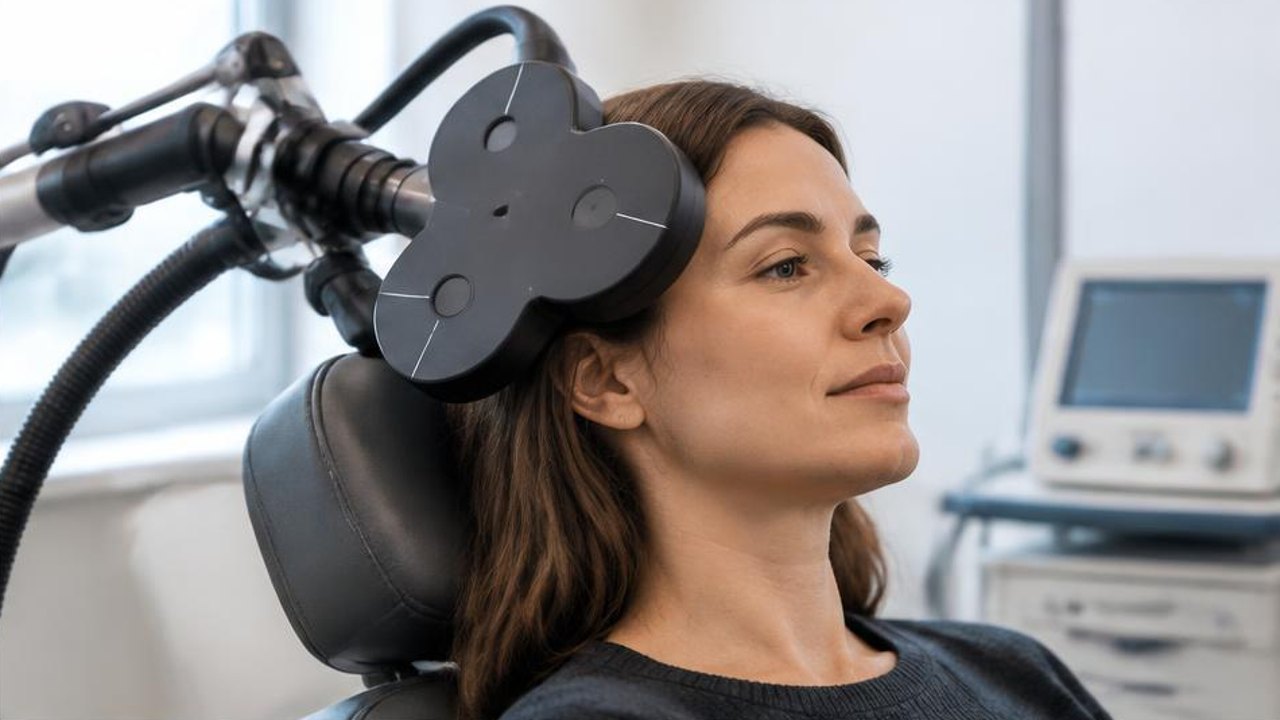
Researchers applied repetitive TMS to the left dorsolateral prefrontal cortex, a frontal brain region. They assessed smoking-related symptoms before and after the treatment course. Measures included the Fagerström Test for Nicotine Dependence, a withdrawal scale, craving questionnaires, and a visual analogue scale.
The authors also used diffusion spectrum imaging to examine properties of white-matter pathways. That imaging component was intended to explore possible biological associations with changes in smoking, not to guide individualized coil placement. It should not be mistaken for a validated test that predicts whether a person will quit.
What changed after treatment?
The study reported lower nicotine-dependence, withdrawal, and visual analogue scores after the 10 sessions. Cigarette consumption also declined, and four participants were reported to have stopped smoking. The authors described withdrawal symptoms as partly alleviated.
These are before-and-after findings within a small group. They describe what happened during the study period, but do not establish how participants would have changed without active stimulation. They also do not demonstrate sustained abstinence months or years later.
The imaging result needs careful language
Researchers reported a change in axial diffusivity in fibers associated with the right nucleus accumbens, a region involved in reward-related circuitry. The change was correlated with the change in cigarette consumption. The authors proposed that this pathway warrants further investigation.
A correlation is not proof that the measured pathway change caused reduced smoking. Nor does a change in a diffusion-imaging metric directly demonstrate that the brain has been repaired. Such measurements require cautious interpretation, particularly when they come from a small exploratory study with several possible outcomes.
Why the missing sham group matters
People may alter smoking behavior for many reasons during a study: motivation to quit, repeated monitoring, expectations, or changes in their daily routine. A randomized comparison with a convincing sham helps researchers estimate how much improvement is attributable to active stimulation rather than those shared influences.
Without that comparison, a treatment-related explanation remains possible, but it is not isolated. This is why the four participants who stopped smoking should not be turned into a promotional success rate. A proportion observed in 18 people is not a stable prediction for a broader population.
Do not treat every TMS protocol as equivalent
The wider TMS field includes different coils, stimulation targets, schedules, and clinical indications. The Mayo Clinic overview describes TMS uses that include helping people stop smoking, while also distinguishing deep TMS from other repetitive TMS approaches.
That broader clinical context does not validate every experimental smoking protocol. Evidence and regulatory status need to be checked for the particular device and treatment being offered. This pilot should not be presented as a new approval or as proof that a depression-treatment protocol will produce the same smoking outcome.
What a stronger study would add
- A larger, randomized active-versus-sham comparison.
- Clearly defined and verified abstinence outcomes.
- Longer follow-up to measure return to smoking.
- A prespecified plan for testing imaging hypotheses.
The practical takeaway
This study contributes a hypothesis about smoking behavior and reward-related pathways. It does not establish a new standard of care or a durable quit rate. Its most useful role is to help shape better-controlled research.
Patients interested in TMS for smoking should ask a qualified clinician about the exact protocol, the quality of supporting evidence, other cessation options, and how success will be measured over time. Reducing cigarette consumption immediately after treatment and maintaining abstinence are different goals that require different evidence.
Sources
Frequently Asked Questions
- How large was the smoking study?
- The pilot included 18 smokers who received 10 sessions of TMS targeting the left dorsolateral prefrontal cortex.
- How many participants stopped smoking?
- The authors reported that four participants stopped smoking after treatment. That observation does not establish a long-term quit rate.
- Did the study prove TMS caused the improvement?
- No. Without a randomized sham-treated smoking comparison group, the study cannot reliably separate stimulation effects from other explanations.
Written by
TMS News Editorial Team
The TMS News editorial team covers transcranial magnetic stimulation research, treatment access, and patient education, drawing on peer-reviewed studies and leading clinical centers.
 PreviousMeasuring TMS Progress: Why Response and Remission Are Different
 NextMotor Threshold in TMS: A Calibration Measure, Not a Depression Score